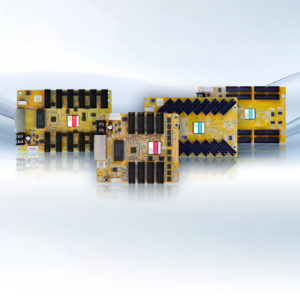
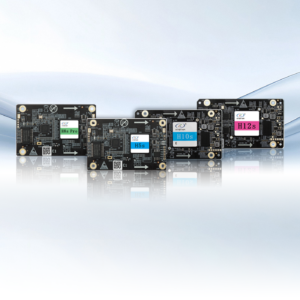
| Feature Focus | KRx Series (Gold Cards) | Hxs Series (Black Cards) |
|---|---|---|
| Series Positioning | Cost-Effective & Highly Reliable Standard Control | Premium Control for Fine-Pitch & High-End Displays |
| Target Applications |
|
|
| Stability |
|
|
| Image Processing | Excellent color reproduction with independent RGB adjustment and dedicated Gamma control | Studio-grade visuals with up to 22-bit Xbits processing, full-grayscale calibration, and native HDR10/HLG |
| Available Models | KR7508, KR7512, KR7516, KR3208 | H5s, H8s Pro, H10s, H12s |
Kystar receiving cards are adaptable and natively support a wide range of mainstream and advanced PWM driver ICs. Supporting up to 32 parallel data groups, both the KRx and Hxs series accommodate various pixel pitches, ensuring seamless integration with your LED modules.
To ensure uninterrupted performance, every Kystar LED receiving card has built-in Loop Backup technology. If a primary network cable disconnects or fails, the signal instantly switches to the backup loop without visible flicker or blackout. For mission-critical setups, the Hxs series also supports dual-card and dual-power backups.
Yes. Mechanical misalignment often causes bright or dark lines between cabinets. Kystar LED screen receiver cards feature proprietary Fast Seam Correction and module batch calibration algorithms. Engineers can quickly fine-tune edge pixel brightness via software, eliminating visible seams and delivering a uniform visual canvas.
It depends on the series. While standard maintenance often requires powering down, the Kystar KRx series (Gold Cards) is engineered to support maintenance without shutdown. This hot-swappable design lets technicians replace a faulty card on the fly, enabling rapid on-site troubleshooting and reducing downtime during live events.
While 18-bit processing works well for general commercial displays, low-brightness environments often reveal color banding and detail loss. The Hxs premium LED display receiving card uses up to 22-bit+ Xbits processing and full-grayscale calibration. This preserves deep color depth and contrast even at very low brightness, making it the industry standard for XR studios, TV broadcasts, and high-end indoor installations.